Discovering American Dippers at Whiskey Falls
What do you have when you combine the skills of a rock climber with those of a pearl diver? Follow along, and you will learn the secret life of one of the most remarkable songbirds found in western North America.
Serendipity was shining on me the day I went hiking on a new trail to escape the summer heat of California’s Central Valley. My hiking partners all settled in for lunch in the cool shade at the base of a multi-fall cascade. But that was not where my thoughts were focused.
As we crossed a bridge on our approach to the falls, I spotted the movement of something I had only seen in photographs. It was a stout little bird foraging upstream in the cold, swiftly moving current. It was not a heron or egret, or any water bird like that. Instinctively, I knew it had to be an American Dipper.
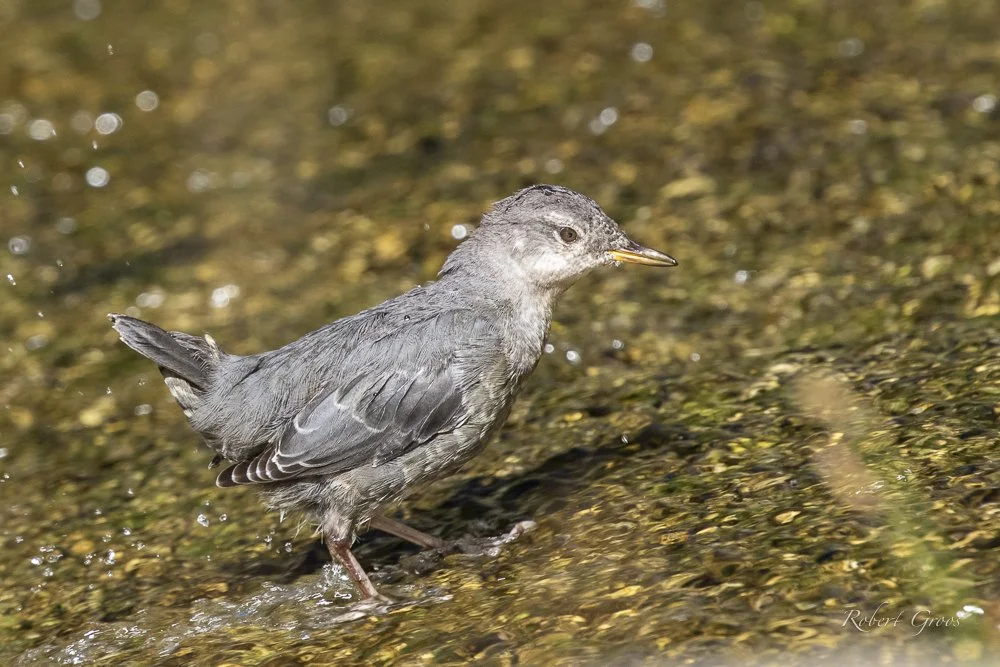
American Dipper walks in fast moving water
American Dippers live alongside fast-moving water where they forage aquatic invertebrates and larvae they find on or below the surface. The shoreline could be caked in snow or ice, but you still might find a dipper there, insulated from the extreme cold by the down feathers covering its skin, and a thick layer of outer plumage waterproofed by preen gland oil. Even their eyelids have feathers.
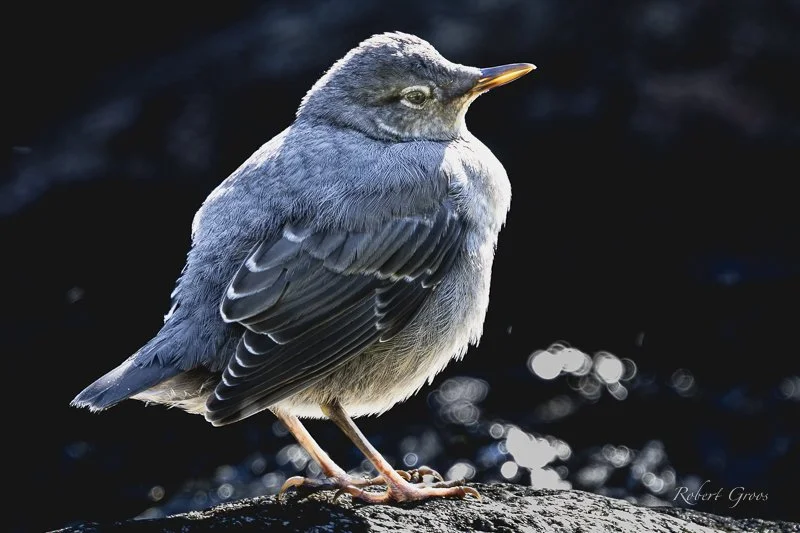
An American Dipper displays its feathered eyelids
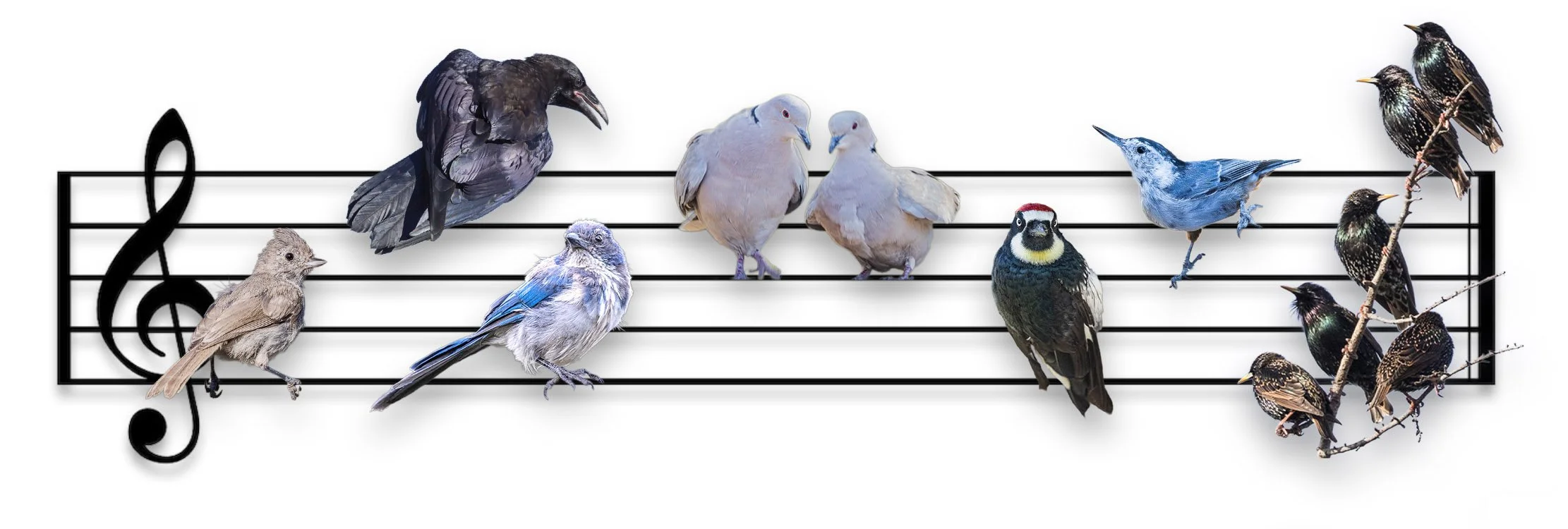
I had long hoped to photograph these unusual birds, but finding them was a challenge. Unlike the birds I commonly see on my property, such as the Western Bluebird, White-breasted Nuthatch, or California Scrub-Jay, American Dippers do not fly around the tree understory, singing a song that alerts you of their presence.
This species is adapted to a strictly linear habitat between the banks of clear, unpolluted moving water. While there are miles and miles of rivers and streams throughout the Sierra watershed, much of it is off-road or in rugged terrain. It's not as if you could simply park your car, and plop yourself down alongside any stream and just wait for a dipper to show up.
Having spotted this uncommon bird, I marveled at my good fortune of finding a location where they could be easily observed. I felt that I had been blessed with a unique opportunity that I would have to pursue. After all, what were the odds I would happen upon dippers when I wasn’t even looking for them? I wolfed down a couple of bites of my lunch, and, foregoing the lively conversation of my hiking partners seated near the falls, I quietly got up and returned to the bridge to verify my identification.
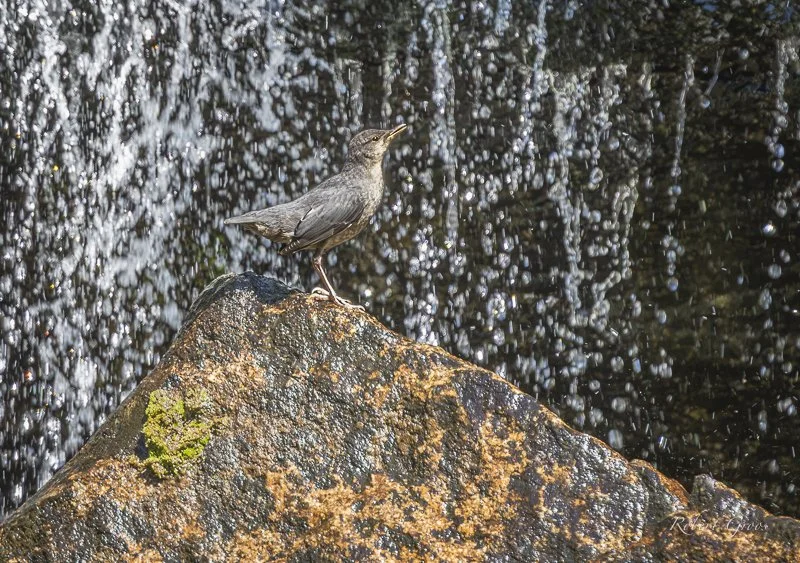
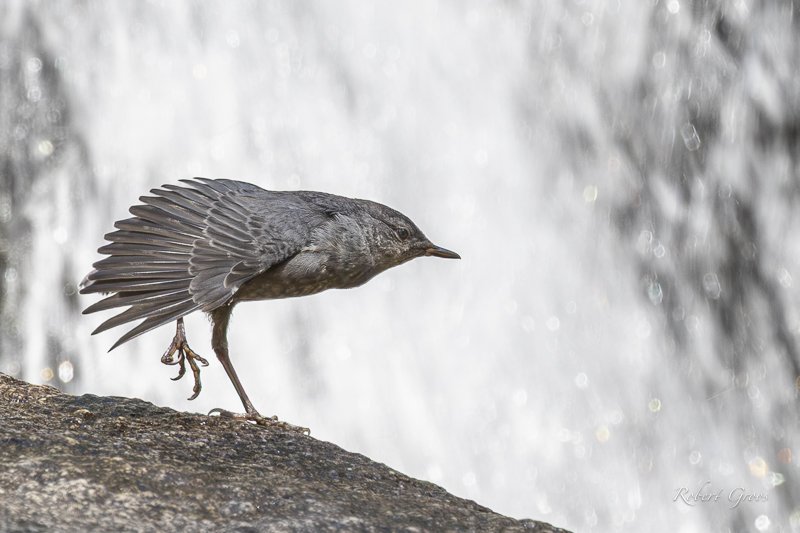
American Dipper stands on boulder showered by waterfall
About a half hour later, their lunches consumed, the hiking group crossed back over the bridge to return to the trailhead. They didn’t see me sitting in the shadows below and continued merrily on their way. I finished what snacks I had left and rushed to rejoin the group. There was a fork in the trail going back to our vehicles that I was unsure of, and I didn't want to be left astray in a place where there was no cell phone coverage.
I carried no camera with me that day, not even a pair of binoculars; I was on a hike, after all. I’d have to return another day with my camera gear and have at it as best I could. So I did, several times.
The riverbank below Whiskey Falls near North Fork in the central California foothills of the Sierra provides an unobstructed view from the falls down to the other side of the bridge, where the stream disappears into a forested ravine. Above the falls, the stream meanders through tall, thick brush which prevents further exploration. The total viewing distance, then, is only about 200 feet.
At times, I would see one or two dippers; other times, I saw none, making the long drive on a potholed forest road not very enjoyable. When dippers were present, though, the experience observing their behavior was entrancing, making the long drive worthwhile.
Why is this bird called a dipper? The name derives from the bird’s hallmark, rhythmic movement: crouching down then standing up, often remaining in place while standing on a boulder, wading in shallow water, or clinging to the granite face of the falls. To give you an idea of the motion, picture an automobile dashboard bubblehead doll—only with feathers—bobbing up and down, again and again. It’s entertaining to watch.
American Dipper forages in swift water looking for food
From where I sat, I saw them fly from just below the bridge upriver to the falls, no more than about five feet above the water. If they flew further upstream beyond the falls, or downstream beyond the bridge, I would sit and wait, often several minutes, for them to return to my viewpoint. They always stayed within the banks of the stream. That restricted riverbank boundary is their territory.
In spite of the din of the cascading water, I could sometimes hear their very high-frequency vocalizations. The pitch of their calls, higher than the sound of the water flowing over the falls and onto the boulders below, is a necessary adaptation the species has developed to communicate in their often loud environment.
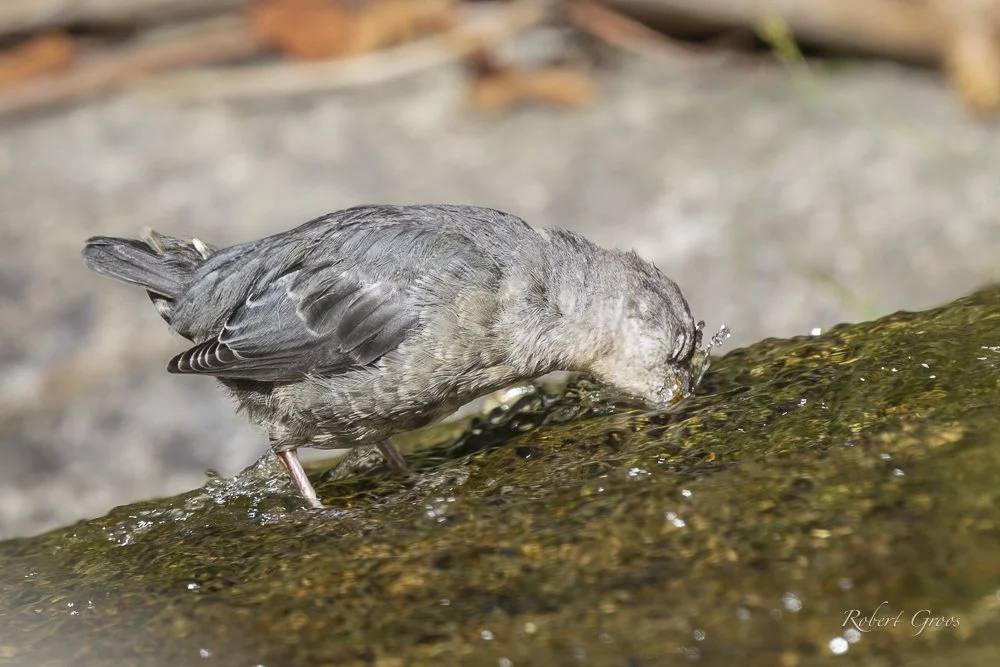
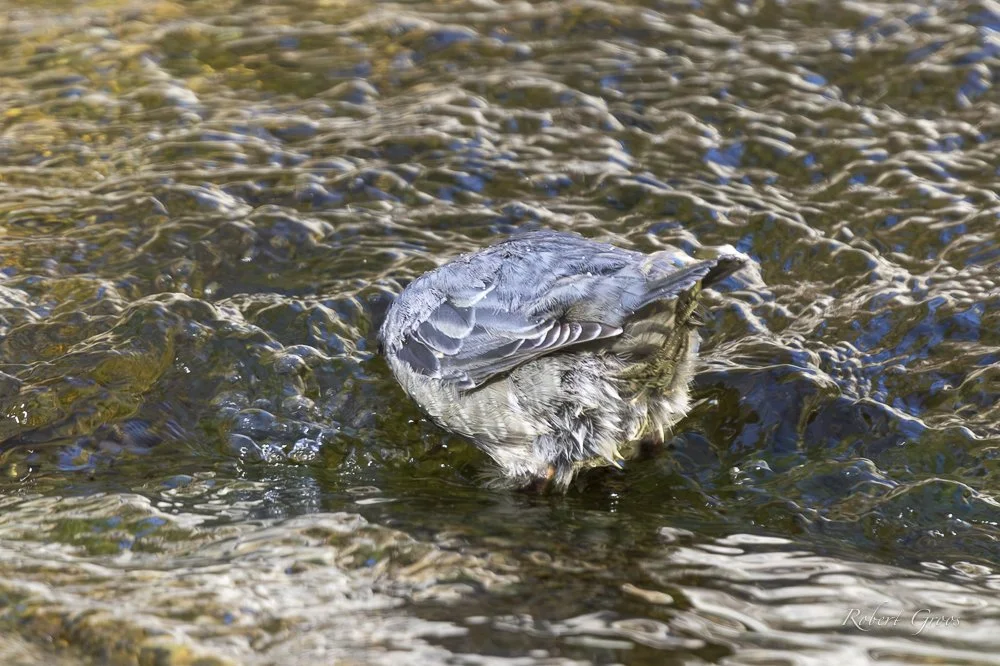
While I never observed a dipper dive into the water from directly above, they would routinely wade before plunging face first into the swift current. In deeper water, they often submerged their whole body and swam underwater—stroking their wings—looking for an edible prize.
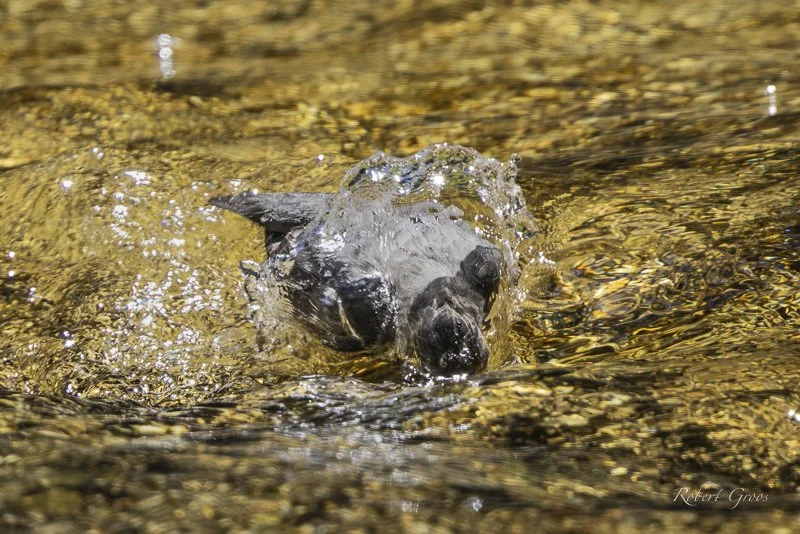
American Dipper plunges face into water looking for food
As a child learning how to swim, do you remember the unpleasant experience of getting water into your nose? Pearl divers, of course, know how to avoid this mishap. And the dippers? No worries, their nostrils have a flap that prevents water from entering.
With their legs spread far apart, the dippers routinely scaled the slippery, moss-covered granite face of the falls. Powerful claws helped them hold on, and never were they swept away. Rock climbers, too, know the drill.
American Dipper clings to rock face of waterfall
A dipper expends considerable energy foraging in this challenging environment. To compensate, it will alternate bouts of foraging with dedicated downtime, preening and drying its feathers, or simply resting on a boulder. I watched one all fluffed up, motionless, for several minutes on the granite bank of the stream. At times, its eyes were closed, as if taking a nap, just like I would do after a hard day’s work.
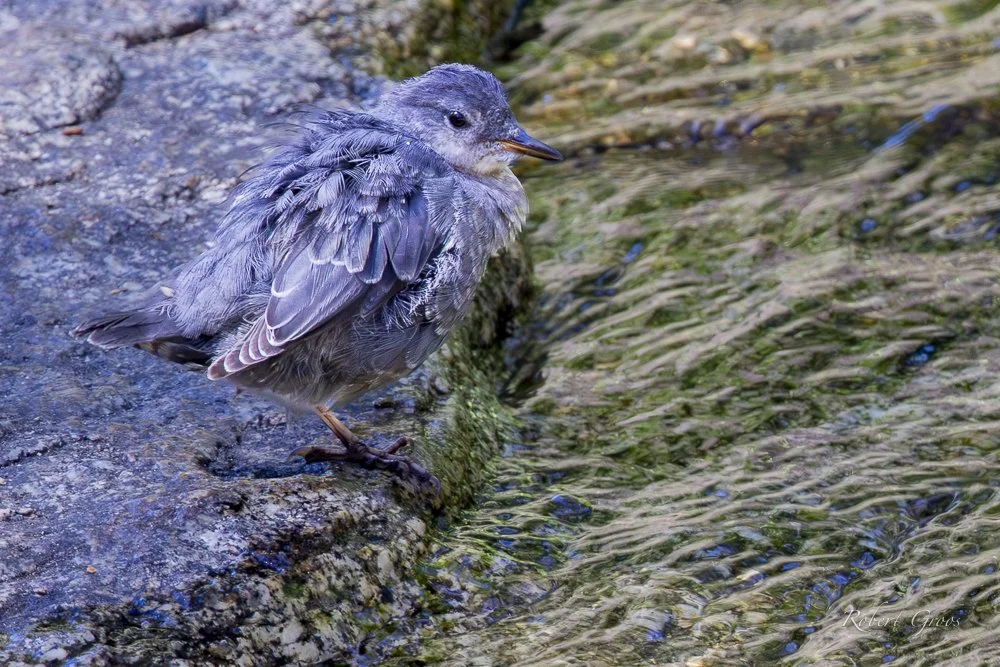
American Dipper rests on granite bank of stream
Whiskey Falls provides the type of environment American Dippers seek for nesting. Ledges on the underside of the bridge, foliage growing on the edge of the falls, and the “cave” formed by the granite outcropping of the falls are textbook locations for building a nest. I had high hopes of discovering one during the several trips I made that spring and summer, to no avail. But the dippers were there, two of them, at least.
The following year, a fire raged through Sierra National Forest land not far away. The stream watershed did not burn, but a year after the fire I no longer saw dippers whenever I visited. I needed to find another location where I might observe and photograph this species.
Hopefully, I asked a few birder acquaintances if they knew any other places tI might explore. They did, and I enthusiastically visited them all. One location was on private property; no parking was available. Another site exhibited no bird activity whatsoever. The third suggestion was along a stream where I regularly hike, but have never seen or heard a dipper there. The fourth spot—considered as reliable—was the Big Creek bridge in Fish Camp, not far from Yosemite National Park. A clutter of trees and dense foliage upstream obscured the view, as well as access to the stream bank. I did spot a dipper there, though, but photography really was not an option.
The fifth option I tried, along the Merced River near the Swinging Bridge in Yosemite, looked as if it, too, was going to be another “washout.” Just about when I was thinking of packing up my gear, I glanced over my shoulder. There, only thirty feet away, was an American Dipper, its body backlit by the early morning sun, and its beak aglow. The eyes were closed, fully displaying its feathered eyelids. The wonder of experiencing that rare moment made all the effort worthwhile.
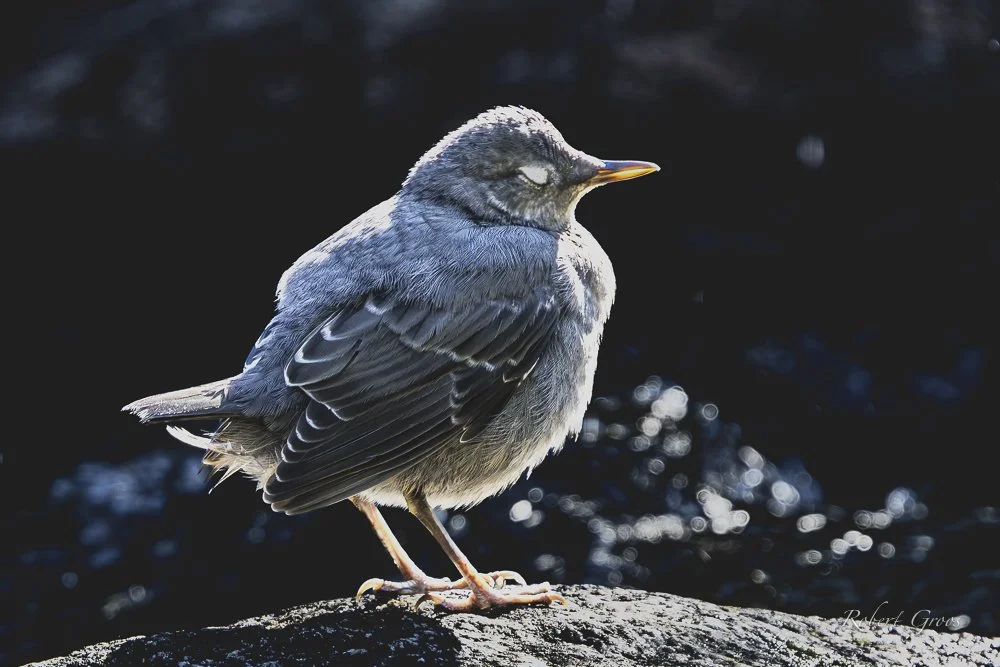
An American Dipper rests with its feathered eyelids closed
Bird photography can be a hit and miss endeavor. Coming home with an empty memory card in the camera is often the case. I’ll keep asking and looking around. Maybe I should try Whiskey Falls once more.
If you enjoyed this post, please share the link with your friends. To be added to my mailing list for future articles, contact me at: robertgroos1@gmail.com. Your information will not be shared, and you can unsubscribe at any time. Thank you.